
Five Things You Should Expect From Your Proposal Software
Interested in testing out YCharts for free?
Start 7-Day Free TrialProposal software is the engine behind how advisors communicate expertise, justify recommendations, move clients to action, and ultimately drive organic growth.
Yet many proposal tools still function like digital slide decks, visually polished, but analytically shallow.
If your proposal software is going to support real advisory work, it should deliver more than aesthetics. Here are five capabilities advisors should reasonably expect.
Table of Contents
1. Benchmark-Driven Portfolio Context, Not Just Pretty Allocation Charts
A proposal shouldn’t simply show what a portfolio looks like. It should explain how it behaves relative to a credible benchmark.
Advisors need to demonstrate why a recommended portfolio is appropriate, not just that it looks diversified. That requires side-by-side benchmarking across allocation, performance, and exposures.
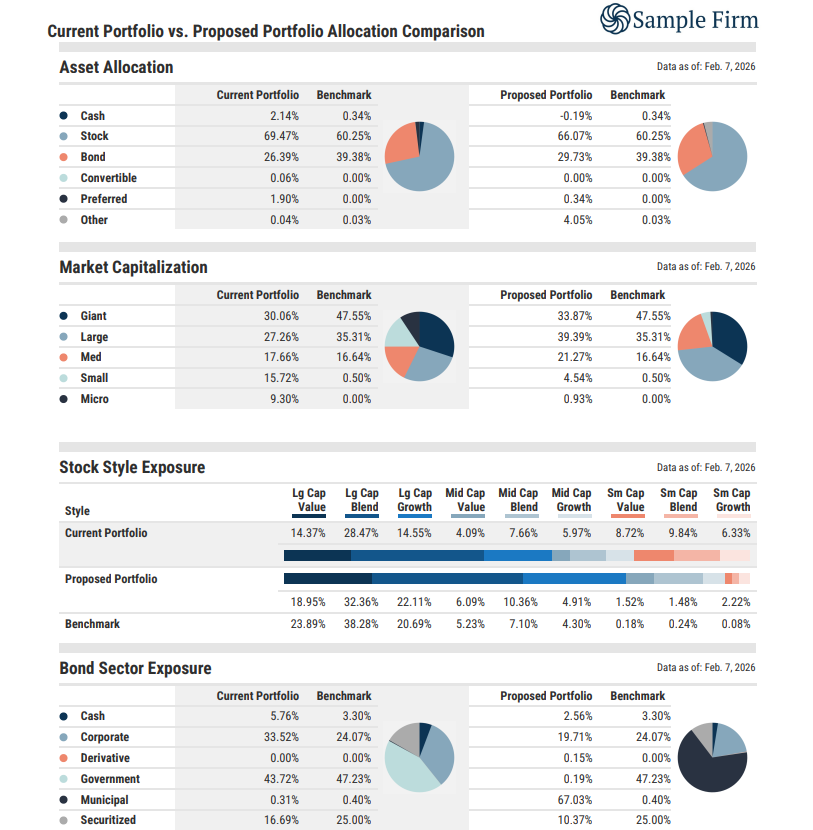
If your proposal tool stops at static allocation visuals without contextual comparison, it leaves advisors filling in the analytical gaps themselves.
Modern proposal software should automatically frame every recommendation within a clear benchmark narrative.
2. Risk That’s Quantified
Clients don’t experience risk as percentages or a Sharpe ratio; they experience it during market stress.
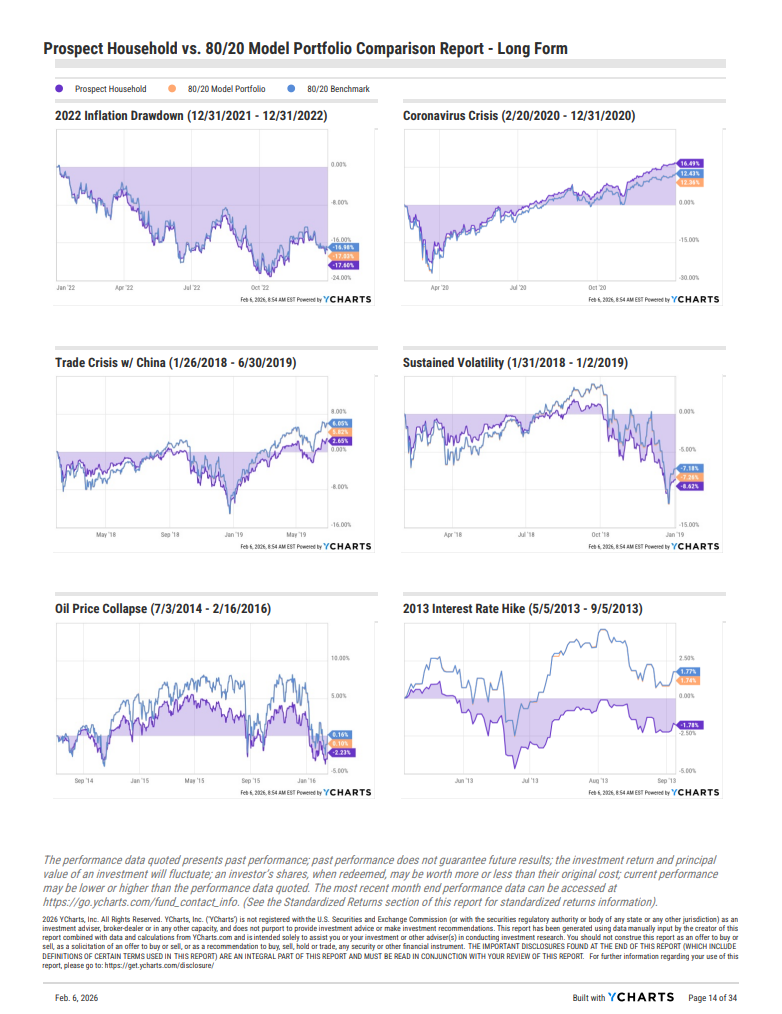
Proposal software should translate portfolio construction into real-world historical scenarios and drawdown analysis. Advisors should be able to show how a portfolio would have behaved during past crises, not just present theoretical risk scores.
It should also make risk profile alignment visible by connecting an investor’s stated tolerance to concrete allocation targets and observable portfolio behavior.
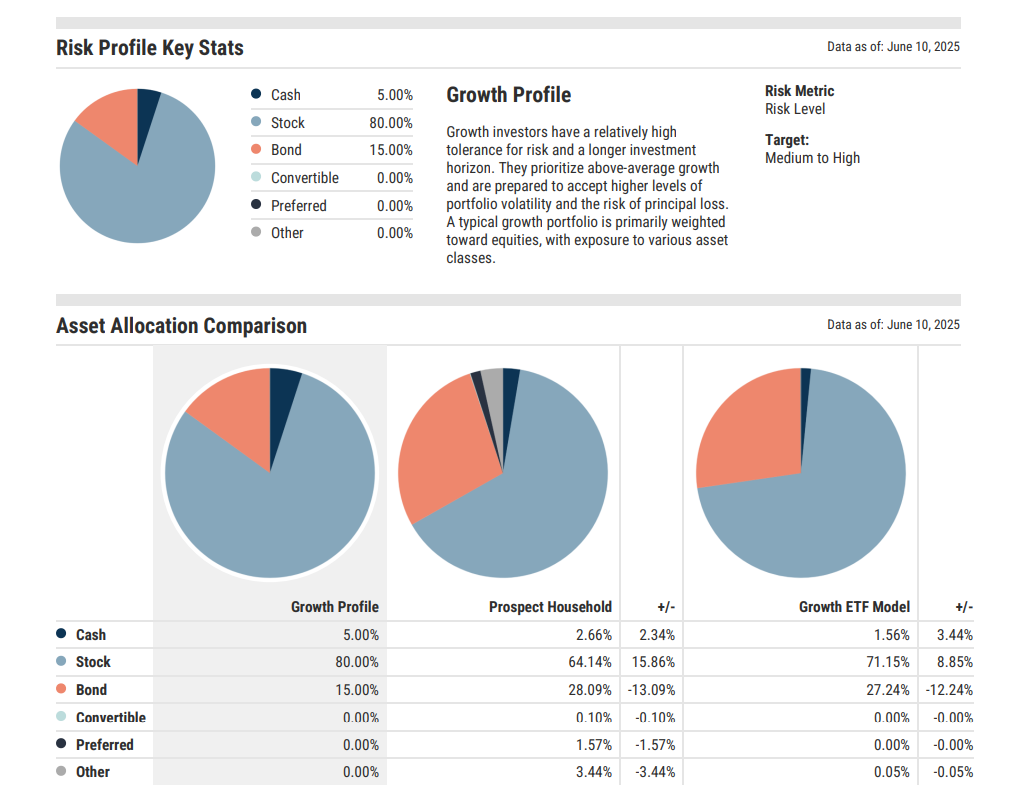
When clients can see how their portfolio maps to the level of volatility they’re prepared to accept, risk becomes easier to understand and discuss.
Tools that rely on generic risk labels or high-level summaries miss a critical opportunity to prepare clients for the emotional reality of market swings before they occur.
A great proposal software turns risk into something concrete and discussable.
3. True Portfolio Transparency
Advisors shouldn’t have to guess what’s inside a portfolio.
Modern proposals should provide deep visibility into underlying exposures, including sector tilts, style biases, credit quality, and underlying holdings, in order to truly communicate any concentration risks.
This level of transparency allows advisors to explain why a portfolio is constructed the way it is.
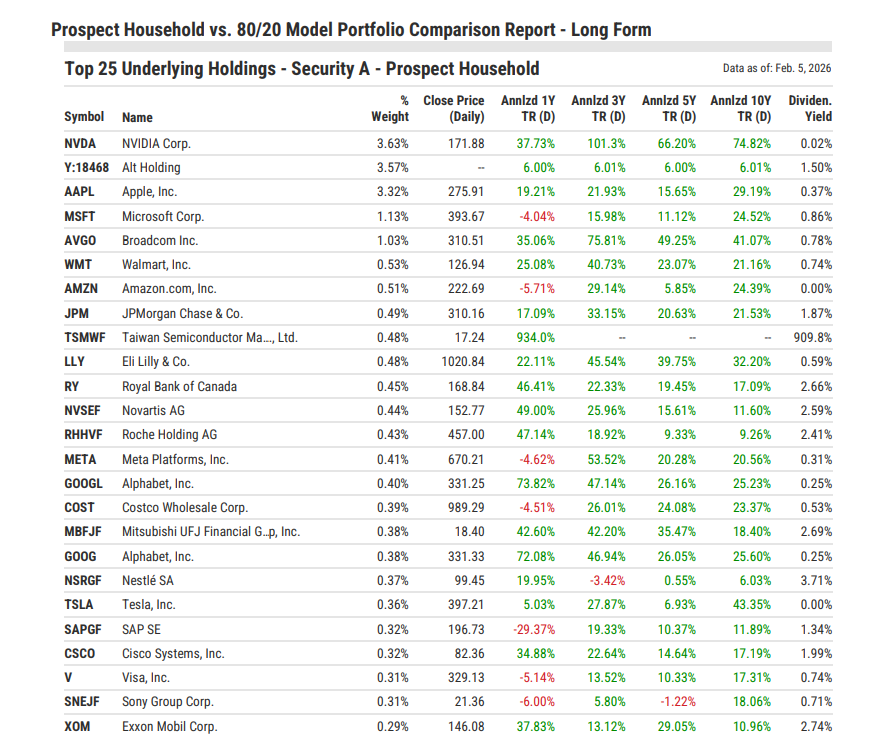
When proposal tools only summarize high-level allocations, they limit an advisor’s ability to answer sophisticated client questions or differentiate their investment process.
Transparency is a crucial part of fiduciary communication. Why shouldn’t your proposal software help you deliver it?
4. Tax-Aware Implementation Guidance
A proposal is only valuable if it can be executed in a tax-aware way.
Proposal software should bridge the gap between strategy and action by outlining a clear transition plan that surfaces both the operational steps and the tax impact of moving from a current portfolio to a recommended one.
Advisors should be able to see — and communicate — the exact trades required, the direction of each change, and the associated tax implications before any action is taken.
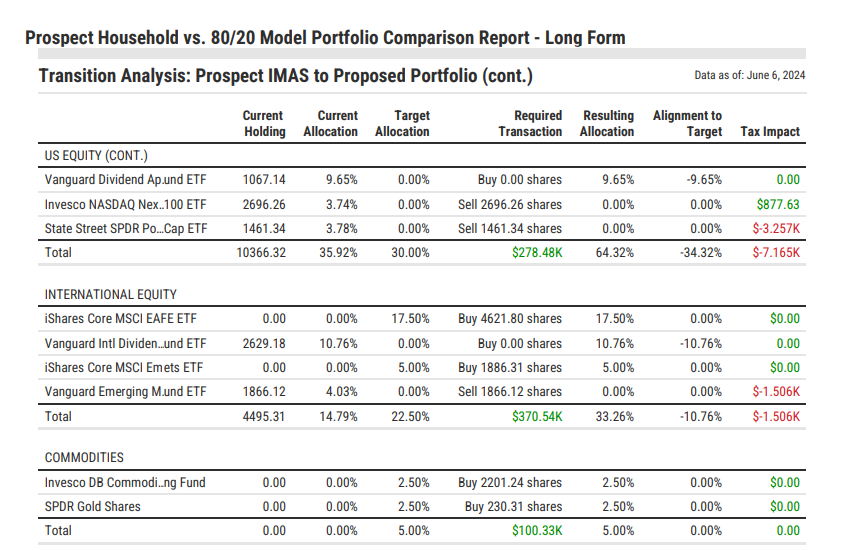
With this level of visibility, advisors can proactively discuss tax sensitivity, sequencing, and implementation strategy with clients, rather than treating taxes as a post-hoc surprise.
Without an integrated transition and tax analysis, proposals remain conceptual. Advisors are forced to manually translate recommendations into trades and estimate tax impact themselves, introducing inefficiency and friction.
Effective proposal software makes implementation transparent and tax-aware.
5. Integrated Cost Awareness
Clients increasingly expect transparency around fees and expenses. Proposal software should make cost discussions straightforward by integrating expense and yield information into the portfolio narrative.
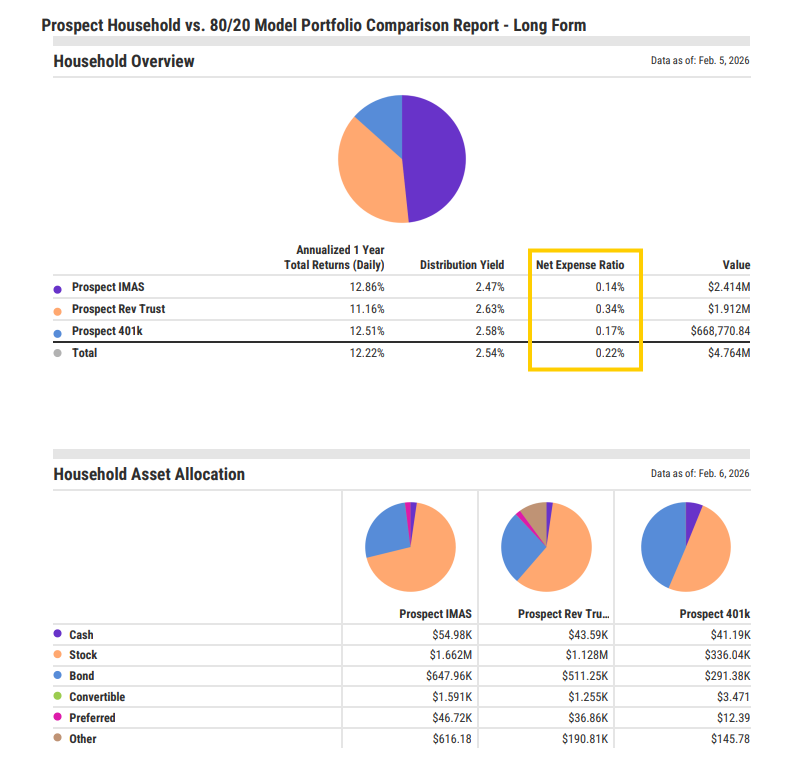
Advisors should be able to contextualize cost alongside performance and risk. It’s not a footnote.
Tools that separate fee discussions from portfolio analytics make it harder to communicate value holistically.
Strong proposal software connects cost to outcomes.
Conclusion
Proposal software should elevate an advisor’s expertise and make it aesthetically pleasing.
The best platforms combine analytical rigor with client-ready communication, helping advisors explain not only what they recommend, but why it makes sense and how it will be implemented.
If your proposal tool feels more like a slideshow than an ROI engine, it may be time to raise your expectations. See how YCharts transforms proposals into a growth driver, schedule a demo, and discover how data-driven proposals can help accelerate your organic growth.
Ready to Move On From Your Investment Research and Analytics Platform?
Follow YCharts Social Media to Unlock More Content!
Next Article
New Hamilton Lane Benchmarks Now Available in YChartsRead More →