
Alternatives Data in YCharts: Strategies, Structures, and Fund-Level Research
Interested in testing out YCharts for free?
Start 7-Day Free TrialAlternatives are no longer a niche corner of the portfolio. Private credit, private equity, and real assets have become regular parts of client conversations, and more advisors are making room for them in client allocations.
YCharts new Alternatives Data brings private capital funds, semi-liquid funds, and private markets benchmarks into the same platform advisors already use for public markets, so alternatives can be evaluated alongside the rest of a client’s portfolio.
Coverage includes 3,000+ private capital funds from managers such as KKR, Blackstone, Carlyle, and CVC; 250+ share classes of semi-liquid funds, such as BDCs and non-traded REITs; 200+ iCapital share classes; and Hamilton Lane private markets benchmarks built for private investments rather than public stand-ins.
Below, we break down the major types of alternatives, how to evaluate them at the fund and portfolio levels in YCharts, and how 300+ other top advisors are incorporating them today.
What Are Alternative Investments?
Alternative investments are assets that fall outside traditional public stocks, bonds, and cash. Advisors often use alternatives to diversify, access specialized income, or gain exposure to investment opportunities that are less correlated with public markets.
Alternative investments generally fall into several categories:
- Private Equity: Ownership stakes in privately held businesses
- Venture Capital: Investments in early-stage companies
- Private Credit: Loans made directly to businesses outside traditional bank lending
- Real Assets: Investments in infrastructure, real estate, energy, and natural resources
- Hedge Funds: Strategies designed around specific market opportunities
- Semi-Liquid Alternatives: Vehicles such as business development companies (BDCs) and non-traded REITs
While alternatives are often discussed as a single asset class, the reality is far more complex. Different structures, managers, and vehicles can produce very different outcomes.
Table of Contents
Who Are the Major Alternatives Providers?
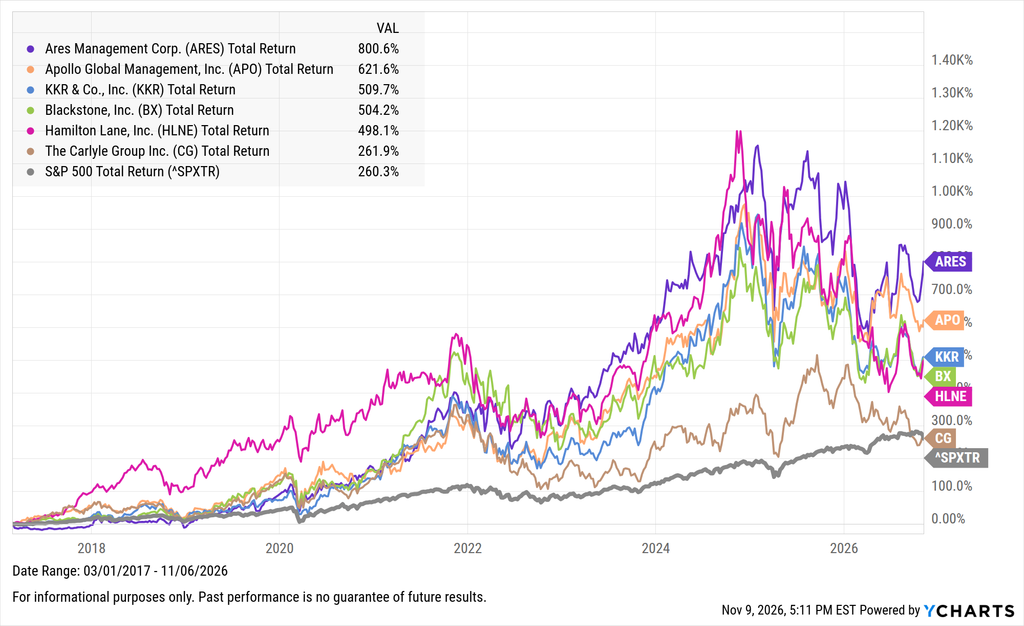
Many of the world’s largest investment firms, including KKR, Blackstone, Apollo, Ares, and Carlyle, manage alternative strategies across private equity, private credit, infrastructure, and real assets. Together, they oversee trillions of dollars in private market assets.
Why Is Public Exposure Different from Private Exposure?
Many investors gain exposure to alternative asset managers through publicly traded securities, such as shares of Blackstone and KKR, or through listed private equity funds and ETFs.
Alternative asset managers differ from most public companies in that investors can have two distinct types of exposure: the publicly traded manager itself and the private funds or other investment vehicles it manages. Those exposures are not interchangeable.
A manager’s stock reflects factors such as fee revenue, performance fee expectations, balance-sheet investments, valuation multiples, and broader equity market conditions. Its funds reflect the performance of their underlying investments, liquidity structure, and valuation methodology.
The distinction matters when evaluating private markets exposure. A manager’s stock performance does not necessarily reflect the performance of the private funds it manages, and the reverse can also be true.
The Problem Is Proxy, Not Returns
Investors seeking exposure to private markets may turn to publicly traded securities as a proxy for underlying private market investments.
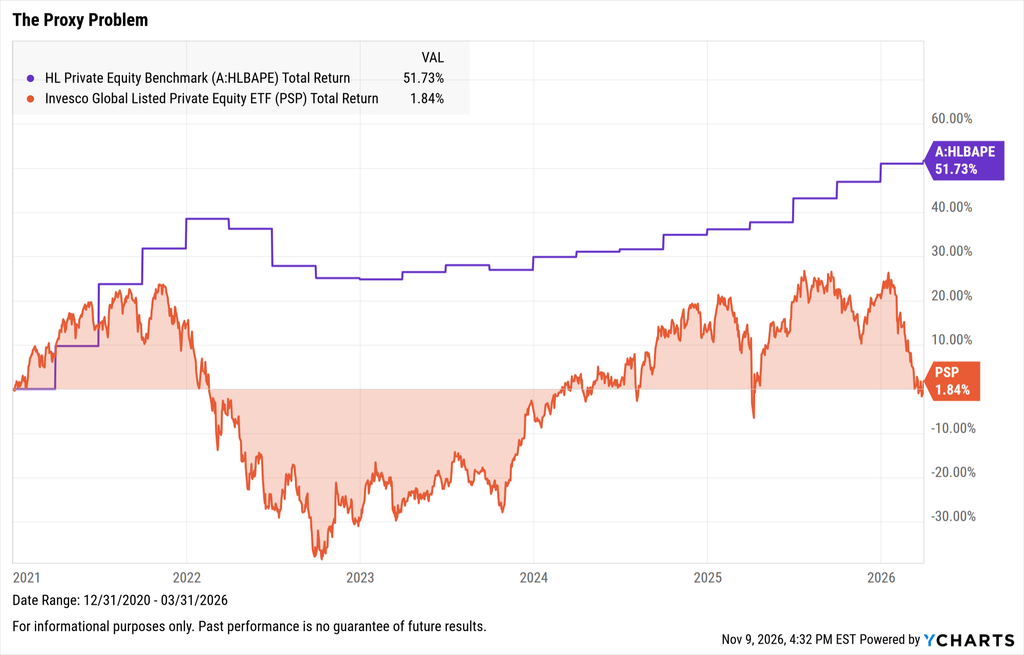
Public securities reprice every day based on market sentiment. Private funds are valued based on the underlying assets they hold and report performance on a different schedule. These differences can lead to meaningfully different performance patterns even when the investments are connected to the same broader market.
If the goal is understanding what a client actually owns, the vehicle and what it’s measured against matter as much as the asset class itself.
Fund-Level Analysis Matters
Private markets are not a single investment category. Outcomes can vary significantly by manager, strategy, and vintage year. That is why Alternatives Data brings fund-level coverage directly into YCharts.
Coverage includes:
- 3,000+ private capital funds
- 250+ share classes of semi-liquid funds
- 200+ iCapital share classes
Available data varies by fund type. Across the add-on funds, you’ll find:
- Fund name and share class
- Manager and strategy
- Performance (Price, Distribution, Yield) and risk measures
Private capital funds include additional fund-level detail:
- Vintage year
- Gross asset value (GAV)
- Money Weighted Performance (IRR, TVPI, DPI, RVPI)
- State and country
- Master/feeder structure
- Alternative classification
Comparing funds from the same vintage illustrates an important point: private market results can vary significantly even among managers operating in similar environments.
Analyze Alternatives Within the Portfolio
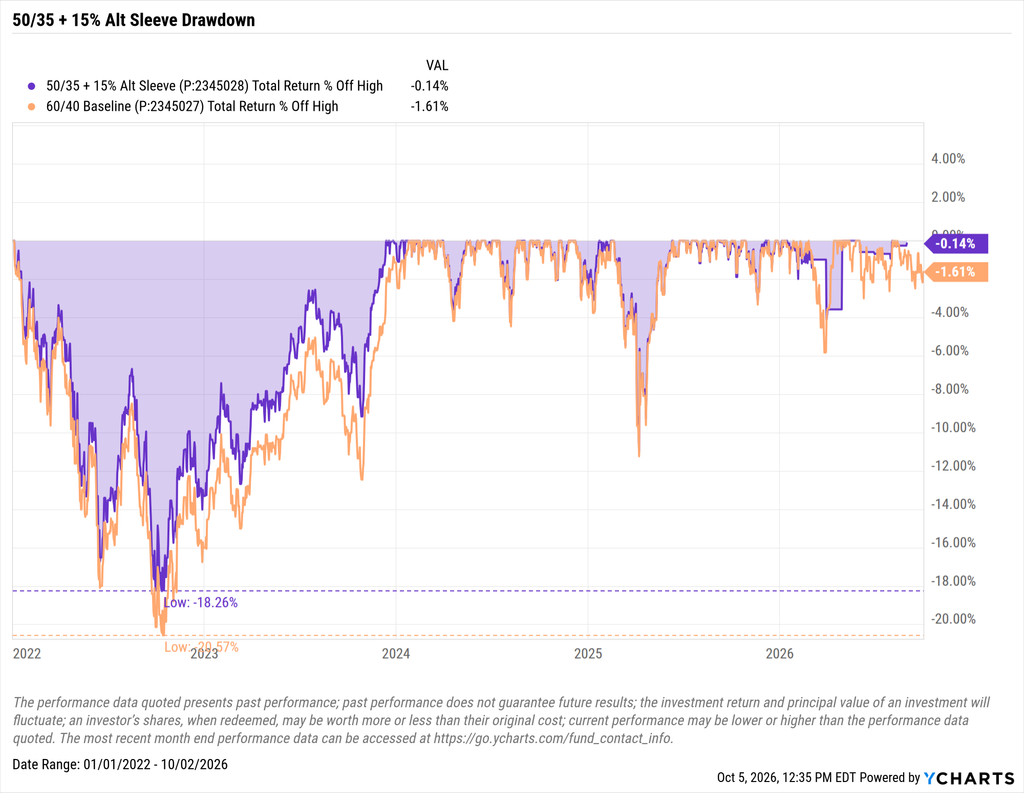
Advisors need to understand how an alternative investment affects the broader portfolio. With Alternatives Data, an alternative can be held and evaluated at the security, portfolio, or household level, so it’s analyzed as part of the whole allocation rather than sitting outside it.
Bringing Alternatives Into One Research Workflow
Alternatives Data extends YCharts beyond public markets by bringing private capital funds, semi-liquid investments, and iCapital funds into the same platform advisors already use for research, proposals, and client communication.
That coverage builds on alternatives data already available on the Alternatives list page, including Hamilton Lane private markets benchmarks, unlisted closed-end funds, and hedge fund strategies. For details on what’s included, see the Alternatives Data FAQ.
Curious How Other Advisors Are Adopting Alternatives?
In From Public to Private: How Advisors Are Using Alternative Investments, YCharts, CION Investments, and Compound Insights surveyed 300+ advisors on how they use alternatives in client portfolios.
95% of advisors reported that alternatives already appear in client portfolios. Infrastructure and real assets (52%), private equity (46%), and private credit (36%) topped the list of categories advisors want to allocate more to, while liquidity, complexity, and client education remain the most common barriers.
Read the full report to see where advisors are allocating, what’s holding them back, and which vehicles they’re using.
Ready to Move On From Your Investment Research and Analytics Platform?
Follow YCharts Social Media to Unlock More Content!
Next Article
2027 Market Outlook Q&A: The Most Hated Bull MarketRead More →