
Anthropic’s Historic IPO Is Coming: What to Tell Clients
Interested in testing out YCharts for free?
Start 7-Day Free TrialWhat Changes When Anthropic Goes Public
Anthropic, the company behind the Claude AI models, is reportedly preparing a Nasdaq listing this fall. If it follows the path SpaceX took earlier this year, it could join the Nasdaq-100 within weeks of its debut. Clients who own funds tracking that index would then own a slice of Anthropic, whether or not they ever bought it.
That makes it one of the more predictable client questions of the quarter. The index mechanics are simpler than the headlines suggest, and the SpaceX listing gives advisors a recent, concrete precedent to point to.
Want to use these visuals in like these in your own presentations? Download our free Monthly Market Wrap slide deck, containing all charts featured in the Market Wrap and more in a shareable, presentation-ready format.
Table of Contents
How Nasdaq’s Fast Entry Rule Works
Newly public companies used to wait months before they were eligible for the Nasdaq-100. In May 2026, Nasdaq adopted a “fast entry” rule that changes that for the largest listings. A new company whose market capitalization ranks among the index’s top 40 members can now be added after just 15 trading days (Reuters via DealStreetAsia).
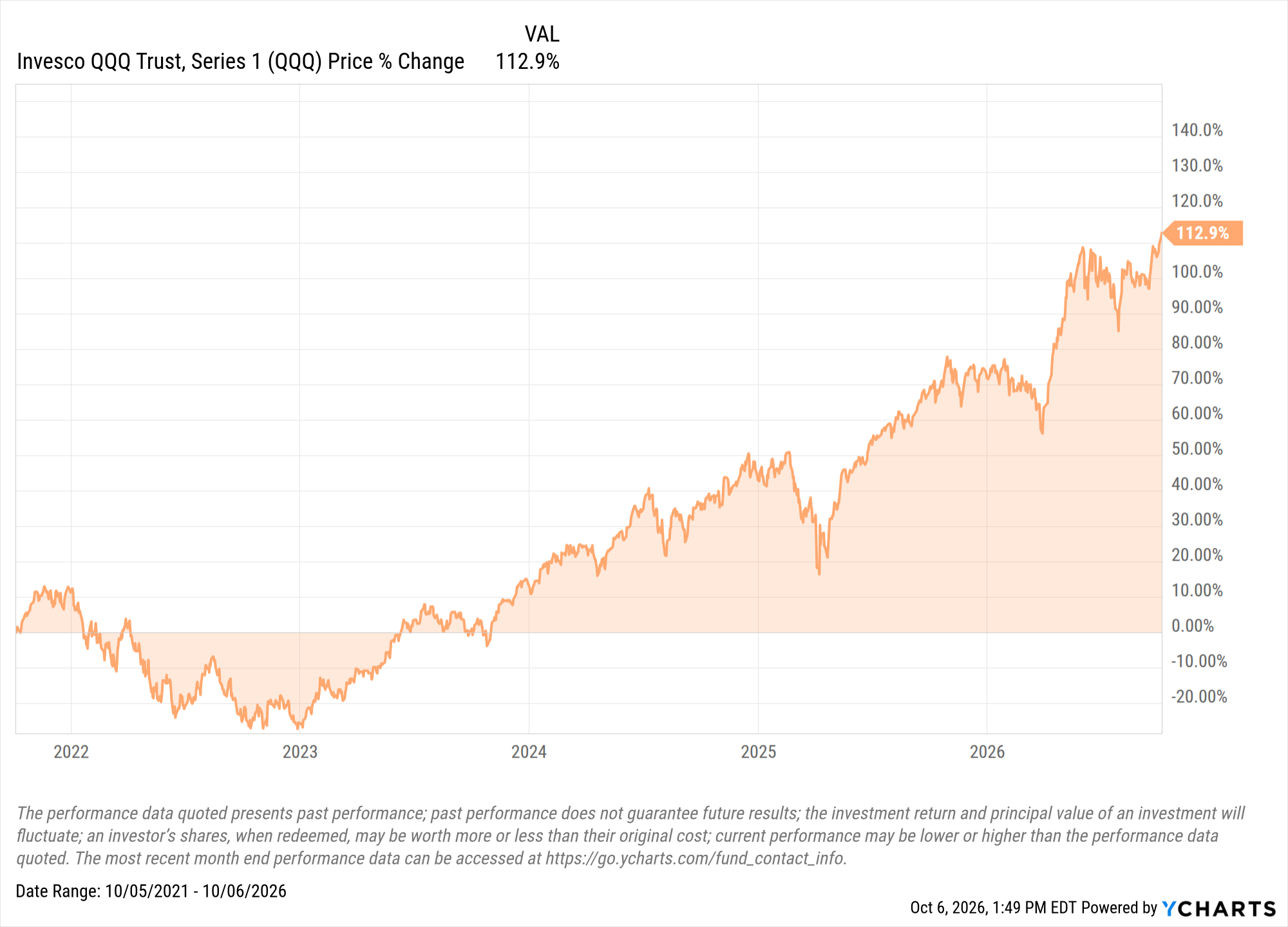
The reason this matters to clients is scale. More than $800 billion tracks the Nasdaq-100, including the Invesco QQQ Trust (QQQ). When a company enters the index, every fund replicating it has to buy shares.
The SpaceX Precedent
SpaceX debuted on Nasdaq on June 12, 2026 and joined the Nasdaq-100 on July 7, one of the first companies to use the new rule (Reuters via The Star). J.P. Morgan estimated the inclusion could draw about $4.3 billion in passive inflows.
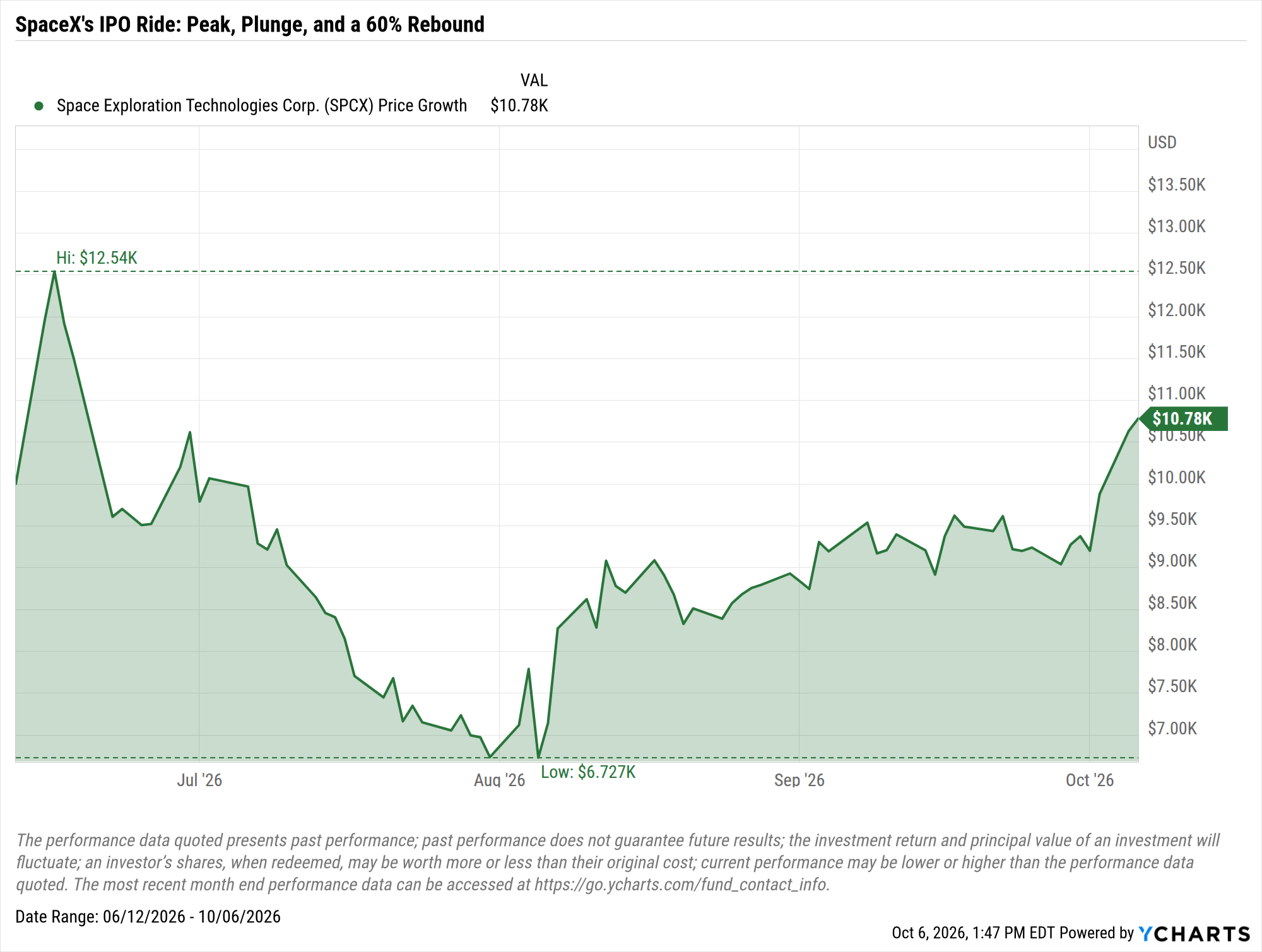
Even so, SpaceX entered the index at a weighting below 1%. Index weights are float-adjusted, meaning only shares available to trade count. Most of a newly public company’s shares sit with founders, employees, and early investors, so the index weight is far smaller than the headline market cap implies.
The forced buying also did not produce a pop. SpaceX shares fell nearly 6% in early trading on the day it joined the index. Index additions are announced in advance, so much of the expected demand tends to be priced in before the effective date.
Other index providers have moved more slowly. S&P Global said it would not change its requirements for SpaceX and would wait at least 12 months before considering it for the S&P 500.
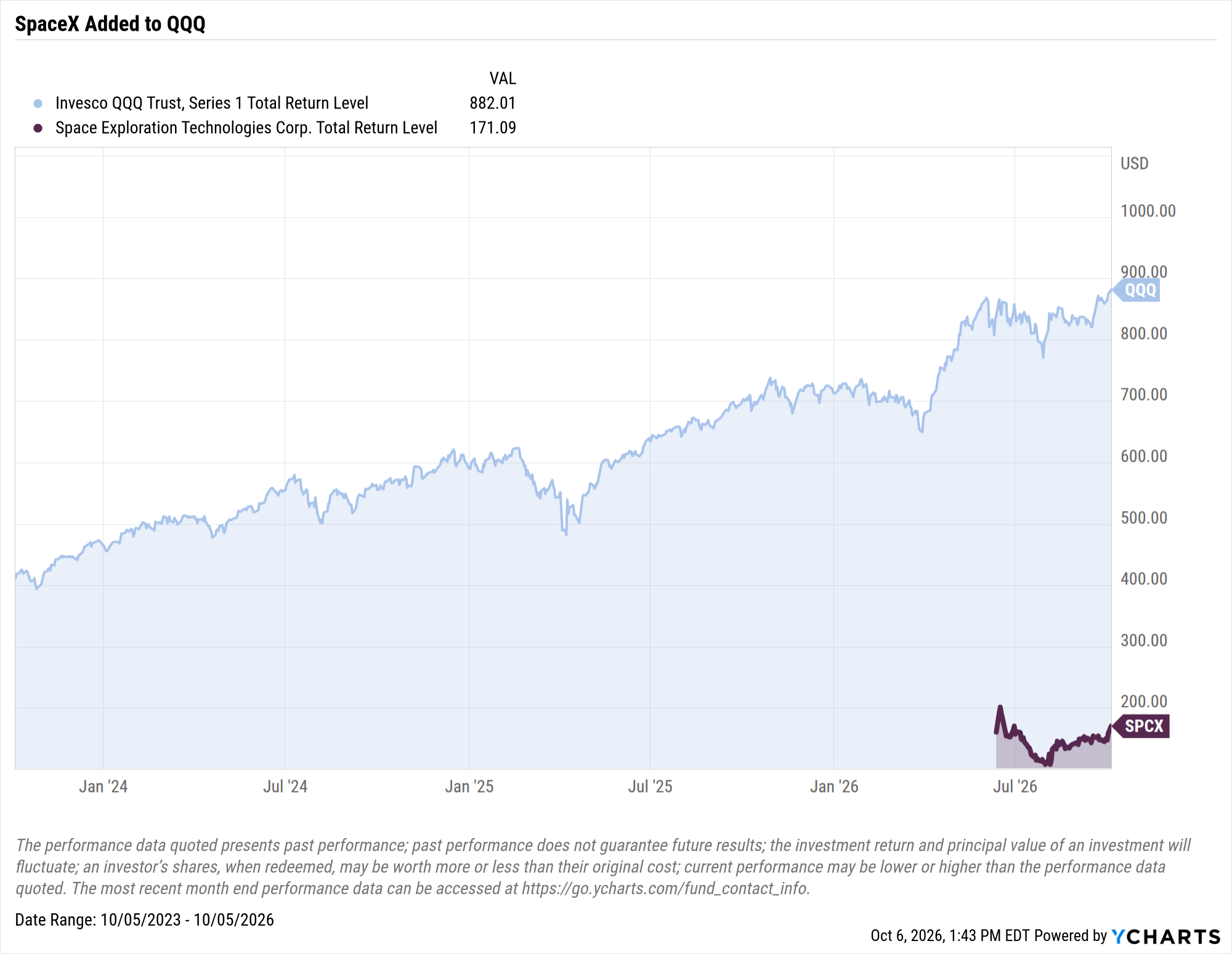
QQQ Total Return Level data by YCharts
What Anthropic’s Listing Could Mean for Index Holders
Anthropic has reportedly selected Nasdaq as its listing venue. Reuters reported the company is expected to begin marketing the offering in mid-October at the earliest and complete the listing before the November midterm elections. None of this is confirmed until a public prospectus is filed, and IPO timelines often shift.
SpaceX, Anthropic, and OpenAI are worth more than every U.S. tech IPO of the past 45 years combined. https://t.co/OFrZN5u4JE
— Steve Rattner (@SteveRattner) September 21, 2026
The scale is what sets this listing apart. At the valuation investors reportedly expect, Anthropic would be worth about $2.0 trillion. Combined with SpaceX at its first-trade value and OpenAI at its discussed private valuation, the three would total roughly $5.2 trillion. That exceeds the $4.1 trillion combined first-day value of all 3,365 U.S. tech IPOs from 1980 through 2025, in nominal dollars.
If the listing proceeds at the valuations being reported, Anthropic would easily clear the top-40 threshold and follow the same fast entry path. Four variables will shape what that means for clients:
- Float size. A larger offering means more tradable shares, a larger index weight, and more forced buying from index funds.
- Rebalancing. Index funds make room for a new member by trimming every existing holding proportionally, so clients’ positions in other names shrink slightly.
- Overlap. Anthropic has investment and cloud partnerships with several of the index’s largest companies, including Microsoft and Nvidia. Adding it deepens exposure to the same AI theme rather than diversifying away from it.
- Broader indexes. If S&P Global applies the same approach it took with SpaceX, broad S&P 500 funds would not hold Anthropic for some time after the IPO.
Client Questions and Talking Points
“Do I Own Anthropic Now?”
Not yet. Once it joins the Nasdaq-100, clients holding a fund that tracks the index will own a small position sized by its float-adjusted weight. Clients in broad S&P 500 funds likely will not, at least until S&P Global decides to add it.
“Should I Buy Shares at the IPO?”
This is a planning question, not a headline question. Clients with Nasdaq-100 exposure will already hold Anthropic indirectly, so a direct position adds concentration on top of it. It also helps to explain that early trading can be volatile and that insider lockups, typically 90 to 180 days, can bring a wave of new shares to market later.
“Won’t Index Buying Push the Price Up?”
Not necessarily. SpaceX drew an estimated $4.3 billion in forced buying and still fell on the day it joined the index. Because inclusions are announced ahead of time, traders often position early, and the effective date can be anticlimactic.
“Is My Portfolio Getting Too Concentrated in AI?”
It is a fair question, and the answer is in the holdings. The Nasdaq-100 is already weighted heavily toward large technology companies, and several of them are Anthropic’s partners and investors. Reviewing the combined weight of AI-linked names across a client’s funds gives a clearer answer than any single headline.
How to Check Client Exposure in YCharts
The most useful client conversations start with what a portfolio actually holds. In YCharts, advisors can:
- Pull fund holdings for QQQ and similar funds to see the top positions and their weights.
- Compare a cap-weighted Nasdaq-100 fund with an equal-weight version to show how much concentration comes from index construction itself.
- Chart price performance of new listings alongside the index to show clients how volatile the first weeks of trading can be.
Bringing those visuals into a review meeting turns a speculative question into a concrete look at the client’s own exposure.
Frequently Asked Questions
When Will Anthropic Go Public?
Reuters reported that Anthropic expects to begin marketing its IPO in mid-October at the earliest and list before the November midterm elections. The company has not confirmed a date.
Which Exchange Will Anthropic List On?
Multiple outlets have reported that Anthropic selected Nasdaq. The exchange and ticker will be confirmed in the public prospectus.
How Quickly Could Anthropic Join the Nasdaq-100?
Under Nasdaq’s fast entry rule, a new listing that ranks among the index’s top 40 members by market cap can be added after 15 trading days.
Will Anthropic Join the S&P 500?
S&P Global has not changed its eligibility rules for recent mega-cap IPOs. For SpaceX, it said it would wait at least 12 months before considering inclusion.
What Does Float-Adjusted Weighting Mean?
An index counts only the shares available for public trading, not shares held by insiders. That is why a newly public company can have a very large market cap but a small index weight.
Whenever you’re ready, there are three ways YCharts can help you:
1. Looking for a tool to help you better communicate market events?
Email us at hello@ycharts.com or call (866) 965-7552. You’ll be directly in touch with one of our Chicago-based team members.
2. Want to test out YCharts for free?
Start a no-risk 7-Day Free Trial.
3. Download a copy of the Monthly Market Wrap slide deck:
Disclaimer
©2026 YCharts, Inc. All Rights Reserved. YCharts, Inc. (“YCharts”) is not registered with the U.S. Securities and Exchange Commission (or with the securities regulatory authority or body of any state or any other jurisdiction) as an investment adviser, broker-dealer or in any other capacity, and does not purport to provide investment advice or make investment recommendations. This report has been generated through application of the analytical tools and data provided through ycharts.com and is intended solely to assist you or your investment or other adviser(s) in conducting investment research. You should not construe this report as an offer to buy or sell, as a solicitation of an offer to buy or sell, or as a recommendation to buy, sell, hold or trade, any security or other financial instrument. For further information regarding your use of this report, please go to: ycharts.com/about/disclosure
Next Article
How AI Continues to Rewrite the Advisor StackRead More →