
Are Gen Z Investors Confusing the Stock Market with the Casino?

Interested in testing out YCharts for free?
Start 7-Day Free TrialGen Z has a lower barrier to entry for investing than any prior generation, but they are also doing so in unconventional ways. Fewer than 20% of these young adults seek professional guidance from financial advisors, opting instead to manage their finances themselves.
In the era of instant access to information, advisors are competing with artificial intelligence and social media for Gen Z’s attention when it comes to investing, and they are falling behind. This generation’s enthusiasm for investing is inherently good, but real concerns lie in where they’re deploying the dollars meant to build their financial future.
Accessibility Is a Double-Edged Sword
Accessibility has expanded for both investing and sports betting, and Gen Z investors are navigating both. Sports betting itself is now legal in 40 states as of 2026, a direct result of the 2018 Supreme Court ruling in Murphy v. NCAA, which struck down the federal law barring states from legalizing it.
This level of accessibility works against a generation primed for instant gratification. An extreme 52% of Gen Z investors have redirected money originally set aside for investing toward sports betting in the past year, according to Betterment’s 2026 Retail Investor Survey, while 26% describe it as a deliberate part of their long-term financial strategy.
This behavior reflects the sources Gen Z uses for financial information, which, for 60% of the generation, comes primarily from social media. When financial education is built on an algorithm highlighting unrealistic gains and “get-rich-quick” opportunities, traditional investment strategies can begin to lose their appeal.
Table of Contents

Download YCharts’ Debunking Investing Myths slide deck, which uses 25+ years of data to dismantle investing myths that often mislead investors and hinder sound decision-making.
The Odds: Casino Games vs. the Stock Market
For a generation that blurs the lines between gambling and investing, it’s worth considering how both strategies affect long-term outcomes, especially for advisors seeking to connect with this group.
While casino games and sports betting are not the same, they both require wagering money on an outcome the player doesn’t control, with odds built in favor of the house. The chances of winning in some of the most popular games are:
- Craps: ~49%
- Blackjack: ~49%
- Roulette: ~47%
- Baccarat: ~45%
Unlike sports betting or casino games, which offer worse odds the longer one plays, investing benefits from compounding growth and has historically rewarded long-term commitment with positive returns.
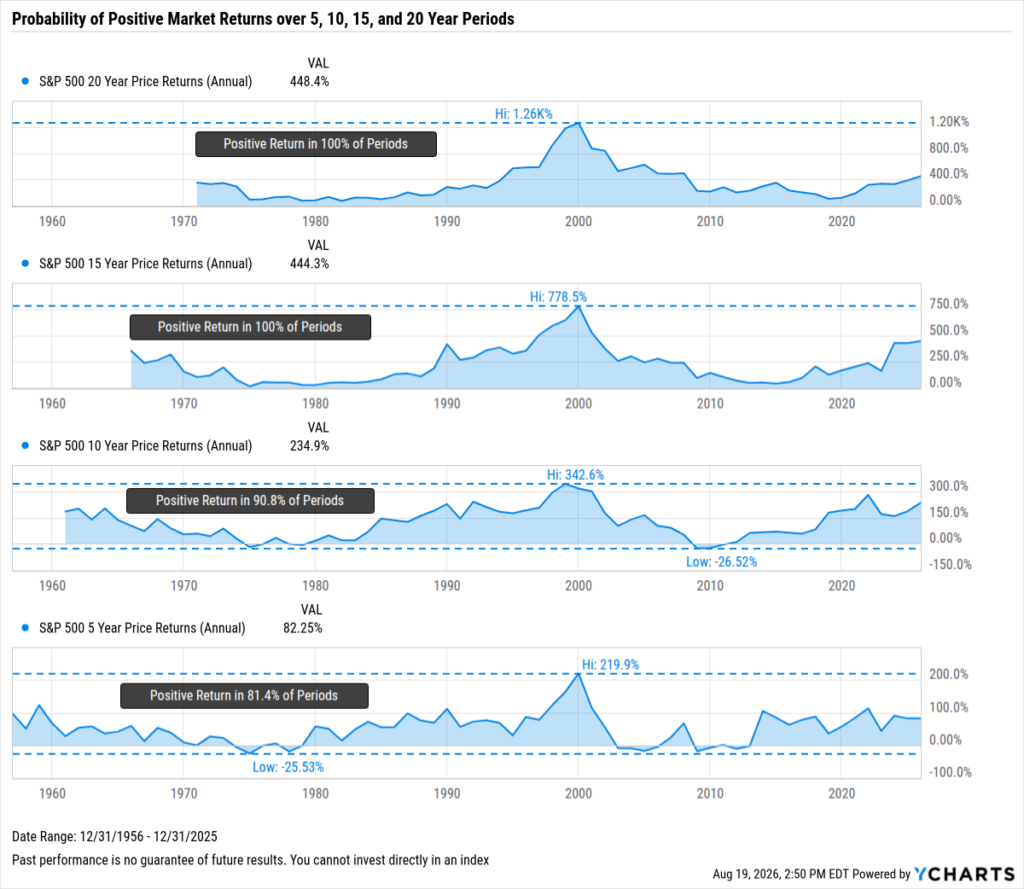
Across various look-back periods since 1956, the S&P 500 has delivered positive returns at least 81% of the time, with increasingly favorable odds the longer the timeframe. Investing always carries risk, but when done thoughtfully, it is an exceptional tool for building long-term wealth.
The Value of Compounding
The value of compounding can be hard to grasp when considering the potential value of investments years down the line. Small amounts on a consistent basis add up, and being able to visualize this is powerful.
Consider an initial investment of $1,000, followed by monthly contributions of $50 over the last 20 years. In a balanced 60% SPY & 40% AGG portfolio, that investment would have grown to nearly 3x the total $13,000 contributed. If entirely invested in the S&P 500, that growth would have surpassed 5x total contributions.
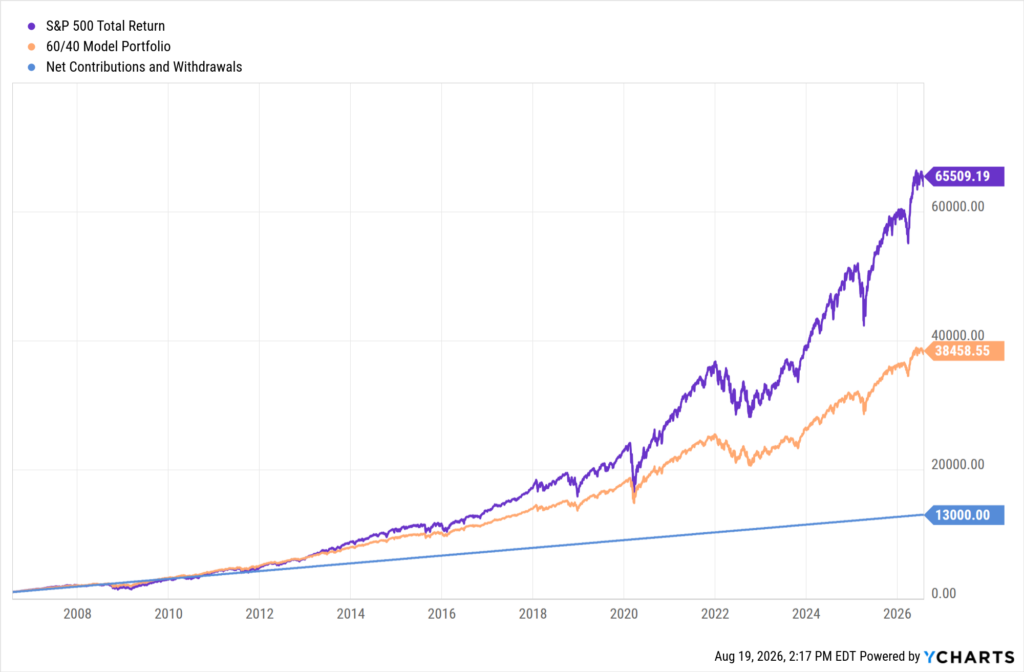
Click to view Scenarios in YCharts →
When looking at the S&P 500 specifically, larger monthly contributions over the same 20-year period scale quickly:
- $75/month: $93,970
- $100/month: $122,440
- $250/month: $293,230
Market Losses Are Recoverable
While markets typically favor investors in the long term, they rarely move in a straight line. There have been countless periods over the past 35 years that felt like reasons to sell, which can be uncomfortable in the moment.
Between January 1 and November 20, 2008, the Invesco QQQ Trust, an ETF tracking the Nasdaq-100, fell 50%. To recover from this loss, the ETF needed a 100% gain, which it achieved nearly two years later.
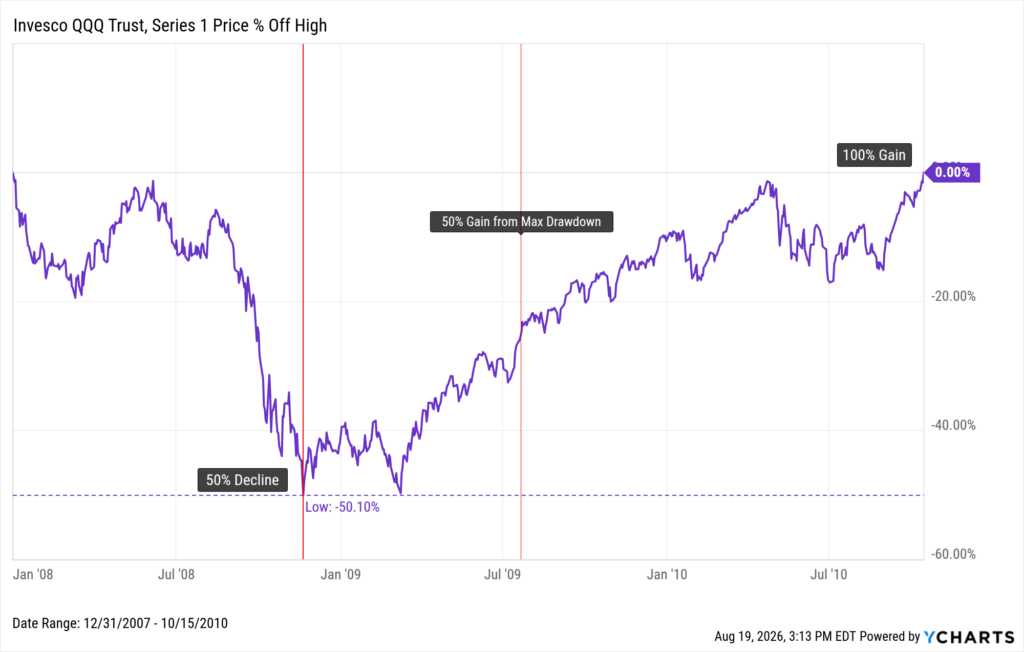
This is the distinction that sports betting and casino games don’t offer. When a wager is lost, there is no recovery period or path back to even; the outcome is final. A market decline, no matter how steep, has historically been forgiven over time for those who remain patient.
Where Advisors Showcase Value
Gen Z has the advantage of time on their side; financial mistakes made now can be recovered and learned from, while money invested properly can set the foundation for long-term wealth.
This is the generation that should be entering the advisor client base right now, even though only a fraction chooses to do so. Advisors who can clearly showcase their value and show up in the channels Gen Z already uses are best positioned to close this gap and win business. YCharts’ suite of tools, including Scenarios, removes the hypotheticals around compounding wealth, allowing advisors to win clients through visual storytelling.
For an additional resource, check out Fired at Inheritance: Why 80% of Heirs Walk Away From Their Parents’ Advisor, and secure the next generation of wealth.
Build these visuals in your own client reports → start a free trial today
Ready to Move On From Your Investment Research and Analytics Platform?
Follow YCharts Social Media to Unlock More Content!
Next Article
New in YCharts: French-Language ReportsRead More →